
about MiNGra
The Middle Low German literary tradition plays a central role in the cultural heritage of northern Europe. From the 13th to the 17th century, Middle Low German was spoken throughout the northern German-speaking and Baltic Sea regions, as well as serving as the trading language in the Hanseatic League’s settlements from London to Bruges, Bergen and Novgorod. Middle Low German texts consequently form the linguistic foundation of the diverse culture of the Hanseatic cities.
Research into the history of northern European cities (municipal laws, administration, social structures), economic history (Hanseatic trade, seafaring, guilds) and religious history (church services, monasteries, personal religious practices) is not possible without a solid knowledge of Middle Low German. Intellectual and cultural developments are reflected in linguistic variation and change. This can be seen in complex text structures, for instance in the case of Middle Low German legal texts, where it is related to the transition from texts designed for reading aloud to those meant for reading on paper. In this way, grammar writing also serves to reconstruct specific linguistic approaches to the world, or to nature and society.
In order to provide an adequate understanding of the structure of Middle Low German, our Middle Low German grammar will incorporate the current standards of modern grammars. It takes into account all levels of the language system (phonology and graphemics, parts of speech, inflection, lexeme formation, syntax) and is also characterised by the following innovative methodological guidelines:
- Sensitivity to variation and diasystemic differentiation: One of the greatest challenges in analyzing a historical language such as Middle Low German — in contrast to a modern standard language — is to systematically map the variants of grammatical forms that consistently occur at all levels of the language. On the one hand this includes variation due to intralinguistic causes (for example the choice of an inflectional element based on the syntactic context for preceding or following adjectives, such as de olde unde nige rat “the old and new council” vs. de rat olt unde nige “the council, old and new”). On the other hand, variation can also appear due to extralinguistic conditions. This means that differences in the use of forms (for example in the formation of the plural for nouns such as brodere vs. broders “brothers”) must be presented according to region, time period, and domain/text type. In order to describe variation adequately, the grammatical description begins at the linguistic surface with the forms as they actually occur, so that the analysis can be derived from empirical evidence rather than abstracted from historical development.
- Corpus-based approach: Only a comprehensive language corpus containing digitally processed texts can provide a suitable empirical foundation. This collection of texts must cover the linguistic period from the 13th to the 17th century and the entire Middle Low German linguistic area (including the Baltic Sea region), as well as reflecting the diversity of text types. For this purpose, the Reference Corpus Middle Low German/Low Rhenish (1200–1650) (ReN) is available; it has been designed for grammatical analysis and enriched with annotations added to word units regarding part of speech and inflectional morphology.
- Suitability for different target groups: The grammar should be usable firstly as a scientific grammar for linguists and researchers from associated areas (for example historians or cultural scientists) to provide both sophisticated analsyes of the grammatical structure of Middle Low German and a comprehensive documentation of the language of this period. It should also be suitable as a usage grammar for academic teaching purposes and as a compact resource for introducing Middle Low German in linguistics and medieval studies.
- Links between grammatical analysis and research data through an interactive web interface: Both the grammar and the underlying data will be available through a web interface. On the one hand, this allows for the greatest possible transparency in regards to the underlying data and methods of analysis, and on the other hand it enables re-use of the data for further studies. In addition, links between the grammar and the ReN corpus allow examples of individual phenomena to be seen in a wider linguistic context. The web interface which will be developed during the project will not only allow classic access to the grammar (for example by navigating through chapters or using the index), but will also provide quantitative visualisations of grammatical phenomena. The following illustrations shows a prototype view of the interactive interface with an example of the dative singular form of the noun knecht ("boy"):
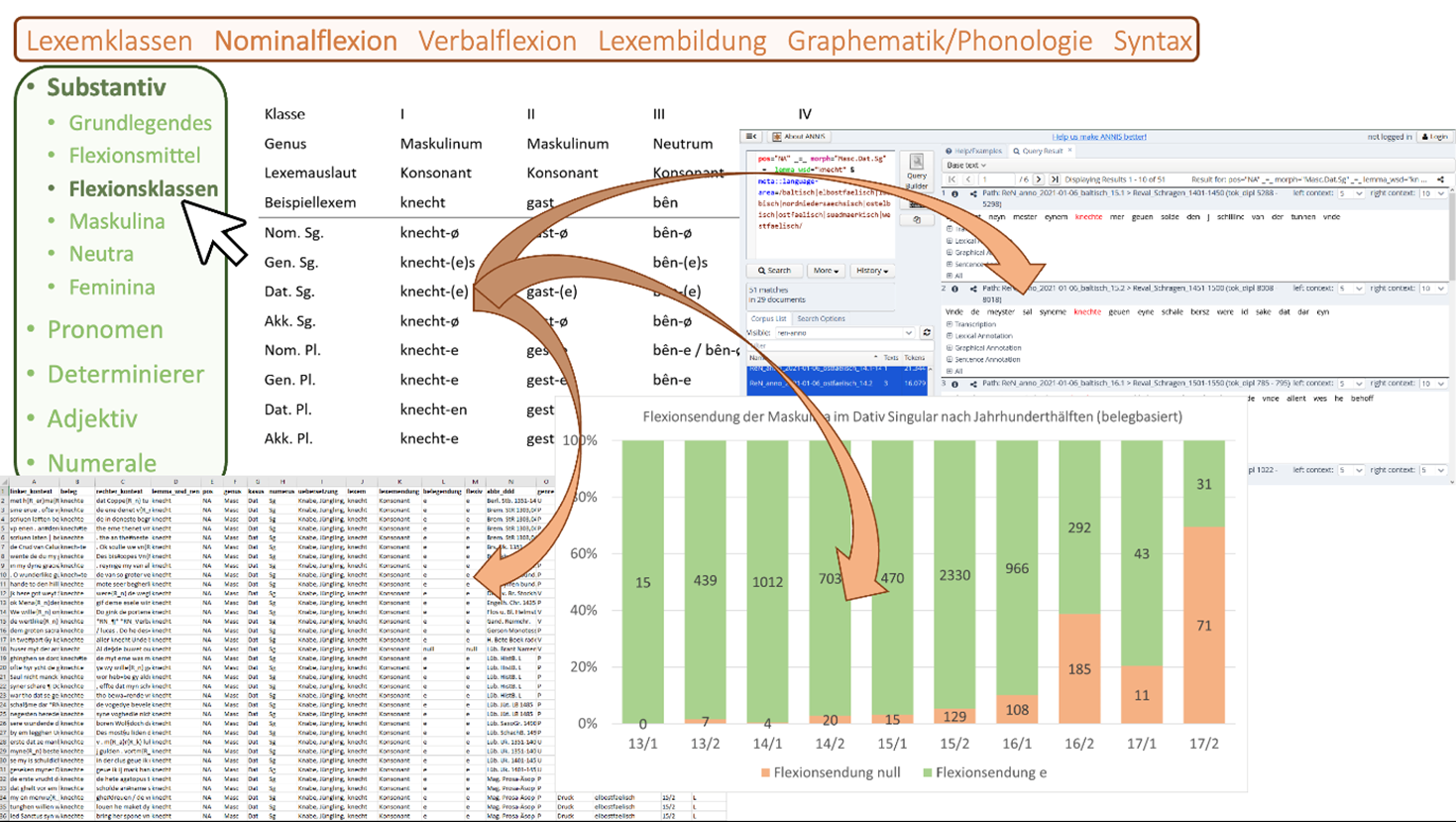
The following levels can be seen in the interface: The examples in the corpus are shown in context (top right), along with visualisations of quantitative distributions, for example the occurences of the competing flexional endings "null" and "e" over time (bottom right), Additionally it will be possible for users to export the underlying data to use in their own research, for example in tabular format (bottom left).